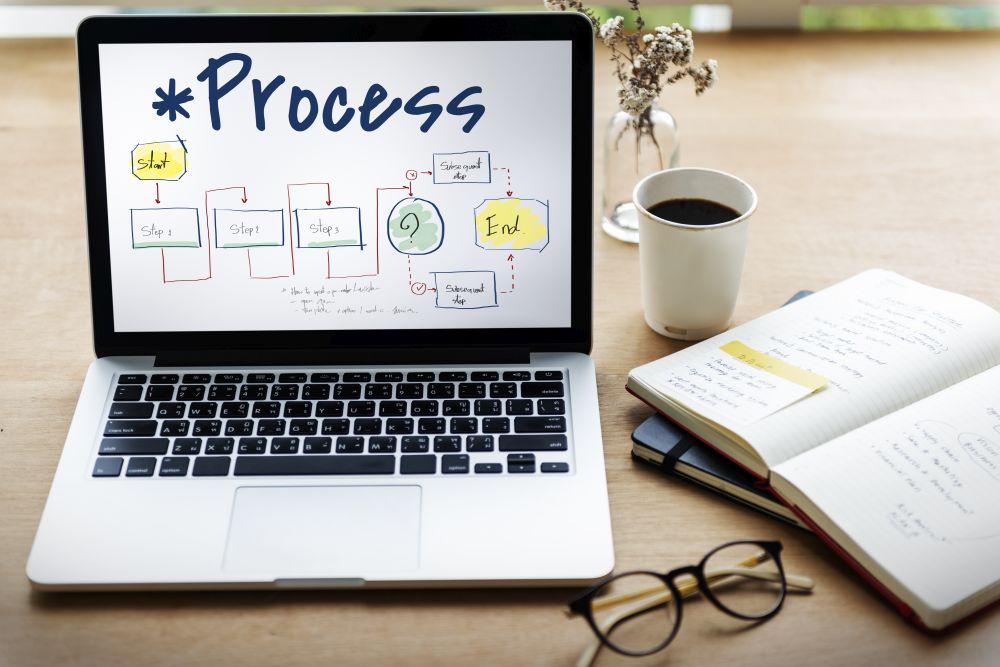
If coordination in your company isn’t working, one possible reason might be that no one has ever sat down and written out how things should actually work. That’s by no means a criticism – it’s simply what happens when a company grows faster than its internal systems do.
Information travels by email, WhatsApp, and word of mouth. Approvals stall because the right person isn’t available. When a key employee goes on holiday – or worse, leaves the company – everything stops. Does any of this sound familiar? If it does, you’re not alone, and nothing is “broken” in your company. It’s a sign that the company has matured to the point where it’s ready for process design.
In this post, I explain what process design is, what it looks like in practice, and what you as a business owner can concretely get out of it.
What exactly is process design?
Proces design is a structured approach to mapping, analyzing, and improving the way your company operates. It’s not an IT project, it’s not a team reorganization, and it’s not the introduction of new software. It’s the step that comes before all of that and the one that makes everything else make sense.
Think of it this way: if you don’t know exactly what steps exist in a given process, who is responsible for what? Or where information most often gets stuck, how will you know which tool you need? Or why a new employee always asks the same questions after a week on the job? Or why the same mistakes keep resurfacing, regardless of the fact that you’ve already “solved” them once?
Process design answers these questions systematically: through conversations with your team, by visualizing what is actually happening, and only then by designing what should be happening. It’s not a one-and-done job, but it is the foundation on which everything else can be built.
What does a company that needs process design look like?
The owners of small and medium-sized businesses I work with rarely come to me saying: I need process design. They come with specific frustrations that, when you hear them together, always paint the same picture.
They say everyone is working hard, but results are inconsistent and they don’t know where the problem lies. They say too much depends on one person, and everything seems to grind to a halt when that person isn’t there. They say they’ve introduced a new tool, but no one is using it properly because the implementation didn’t follow the logic of the work. They say onboarding new employees looks different every time and takes too long. And, perhaps most commonly, they say they can’t delegate and verify that things have been done, because all the steps of the work are still only in their own head.
If you recognized yourself in at least one of these, those are the classic symptoms of a company that’s missing process design. And the good news is that all of these symptoms can be addressed systematically — without fighting fires week after week.
The 6 steps of a process design project
Every project I run moves through six stages. Here’s what that looks like in practice, step by step.
- The first step is looking at the inventory. Together, we map out all the processes in the company – which ones exist, which are critical, who owns them, and which have no clearly defined responsibilities at all. Most business owners realize during this phase that they didn’t have a complete picture themselves. This is the starting point without which no further work is possible.
- The second step is conversations with the team. We talk to the people who work within these processes every day, because they know exactly where things get stuck, which steps make no sense but everyone follows anyway, and what happens when a key person isn’t around. That knowledge exists in every company; it just hasn’t been systematically brought to the surface and written down in one place.
- The third step is mapping or the so-called AS-IS picture. From the conversations, a visual representation emerges of the process as it exists today, complete with all its gaps, ambiguities, and steps that exist only because they always have. It’s only when you see it in black and white that it becomes clear where to start and what actually needs to change.
- The fourth step is design or the TO-BE state. I work through this part together with the team, not instead of them, because a process that people have shaped themselves is far more readily adopted than one delivered ready-made by an outsider. We define what the process should look like: which steps stay, which change, who approves what and by when, and where everything is documented.
- The fifth step is selecting and setting up the tools. Only now does it make sense to talk about technology. Sometimes that means configuring a platform the company already has; sometimes it means choosing something new. In either case, the tool comes after the process (never the other way around) and that’s the difference between an implementation that gets adopted and one that collects dust.
- The sixth step is training. The last and most underrated step. The team works through the new system using concrete examples from their own day-to-day work. Because a tool that people understand and that makes sense within the context of their job is a tool that will actually get used.
What do you as a business owner get out of this?
At the end of a process design project, clients receive something that at first glance looks like documentation: visual process maps, RACI matrices (R = Responsible; A = Accountable; C = Consulted; I = Informed), checklists. But what they actually get is far more valuable than that.
You get a team that knows what to do and when, without you acting as the go-between at every step.
You get processes that function even when key people are absent.
You get the ability to delegate that doesn’t depend on your constant presence.
You get completed steps you can track as the owner.
You get company growth without having to rebuild the process from scratch every single time.
In a word, you get a company where the processes work for you and your employees. And that, in the experience of my clients, is a feeling that’s hard to describe until you’ve experienced it yourself.
Process design isn’t for companies that are just starting out and still experimenting with their model. It’s for companies that have grown enough to feel the friction of everyday chaos — and are ambitious enough to want to solve it once and for all, rather than patching it up week after week.
I hope this text was useful to you, and if you have additional questions, feel free to contact me.
HR Consultant